
When Policy Forgets People

The real cost of inflexible workplace leadership and what human-centered HR looks like instead.
What a $22.5 million verdict, a mother's impossible choice, and a
baby named Magnolia teach us about workplace flexibility, human-centered
leadership, and the true cost of rigid management.
IN THIS ARTICLE
Imagine you are four months pregnant. Your cervix has been surgically
reinforced to prevent early labor. Your doctors have given you clear,
documented instructions: reduce physical strain, minimize commuting,
protect this pregnancy.
You go to your employer and ask for one thing. Not a raise. Not a new title.
Not additional benefits. You ask to work from home for a few weeks while
you follow your doctors' orders and protect the life growing inside of you.
They say no.
That is not a hypothetical. That is what happened to Chelsea Walsh in February 2021 when she worked for Total Quality Logistics, a freight brokerage firm in Cincinnati, Ohio. According to her lawsuit, TQL gave her an impossible choice: return to the office and risk her high-risk pregnancy, or take unpaid leave and lose both her income and her health insurance.
She returned to the office.
Nine days later, she gave birth to a daughter she named Magnolia. Magnolia was
between four and five months along. She had a heartbeat, was breathing, and was placed on her mother's chest. She died in Chelsea's arms approximately ninety minutes later.
On the same day Magnolia was born, TQL's manager informed Chelsea that the
company had reconsidered and would allow her to work from home after all.
In March 2026, a jury ordered TQL to pay $22.5 million in damages.

I want to be careful here. This article is not a legal analysis of the verdict. It is not a
news recap. And it is not an attack on any single organization.
This article is about something deeper. It is about what happens inside
organizations when policy operates without empathy, when managers enforce rules without exercising judgment, and when workplace culture quietly teaches people that the needs of the business will always outrank the needs of the human being sitting across the desk.
Because the verdict is $22.5 million. But the cost to that family is immeasurable.
The Impossible Choice Nobody Should Have to Make
One of the most chilling details in Chelsea Walsh's lawsuit is not the denial itself. It is the framing of it.
According to the suit, TQL presented the situation as a choice. Work from the office, or take unpaid leave without health coverage. A binary. A policy decision.
What that framing erased was the fact that it was not a business negotiation. It was a woman's pregnancy. Her doctor's orders. Her baby's life.
This is how institutional thinking distorts reality. When we reduce a human situation to a policy category, we lose the ability to see it clearly. We stop asking "what does this person actually need?" and start asking "what does the handbook say?"
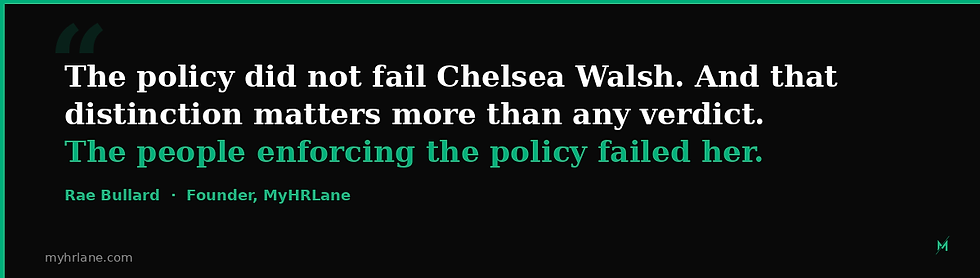
Policies are tools. They exist to create consistency, reduce risk, and guide decision-making at scale. But a policy is not a moral compass. It does not know the difference between a minor inconvenience and a medical emergency. It cannot weigh the cost of a decision against the full weight of its human consequences.
That judgment belongs to people. To managers. To HR professionals. To leaders.
When we train our managers to execute policy rather than exercise judgment, we
create organizations that can do exactly what TQL's leadership did: deliver a
technically defensible answer to a situation that called for a human one.
L E G A L C O N T E X T
The Americans with Disabilities Act and the Pregnant Workers Fairness Act both
require employers to engage in an interactive process and provide reasonable
accommodations for pregnancy-related conditions. A documented high-risk
pregnancy with a physician's recommendation for reduced physical activity is not a gray area. It is a covered condition with a clear legal pathway. The tragedy is not that the law was ambiguous. It is that someone in a position of authority chose not to use it.
Where Leadership Failed: A Timeline
This was not a single decision made in a single moment. It was a series of choices
made by multiple people over multiple days. Each one was an opportunity to
choose differently.

THE DETAIL THAT DEFINES IT
The reversal came through a personal connection, not a process
According to the lawsuit, TQL only reconsidered after Chelsea's husband raised her situation with his own company's HR manager, who happened to be friends with a TQL executive. The executive's response, per the suit: "Thank you. You just saved us a lawsuit." The accommodation was not granted because it was right. It was granted because the right person finally heard about it.
That last detail is the one that stays with me. The accommodation was always
available. The flexibility always existed. What did not exist was a system, a culture, or a manager willing to exercise judgment on behalf of an employee who deserved it.
The Real Cost of Inflexible Workplace Policy
The $22.5 million verdict will dominate the headlines. But the actual cost of inflexible management rarely shows up on a balance sheet.
It shows up in the employee who stops asking for what they need because they
have learned the answer will be no. It shows up in the talented person who quietly
updates their resume after their manager proves, in a single interaction, that the
company does not see them as a full human being. It shows up in the culture of
silence that develops when employees learn that vulnerability leads to punishment rather than support.

Inflexible policy is not just a legal risk. It is a retention risk, a culture risk, and a trust
risk. When employees watch a colleague be denied a reasonable request, they do
not just feel sorry for that colleague. They update their understanding of how this
organization values people. They file that information away and make decisions
accordingly.
The employees who leave are often the ones with the most options. The ones who
stay carry the weight of knowing what kind of organization they are working for.
H R I N S I G H T
Psychological Safety Is Not a Wellness Program
Psychological safety is not a benefit or a policy statement. It is the lived experience of knowing you can raise a concern, share a need, or ask for help without fear of retaliation, judgment, or dismissal. It is built or destroyed in individual interactions between employees and their managers, one conversation at a time.
When an employee with a documented medical need is told their options are
"come in or go without pay," psychological safety does not just diminish for that
employee. It disappears for every person who hears that story. And in most
organizations, everyone hears that story.
What Caregiver Realities Look Like in 2026
One of the persistent disconnects in modern workplaces is between the reality of
employees' lives and the assumptions built into the systems designed to manage
them.
Most of our workplace structures were designed around a specific model of the
worker: full-time, physically present, without significant caregiving responsibilities,
and able to separate the professional from the personal in a clean and reliable way.That model was always a fiction for many people. In 2026, it is a fiction for most.
More than half of today's workforce has primary or significant caregiving
responsibilities. That includes parents of young children, people supporting aging
parents, individuals managing chronic health conditions, and pregnant people
navigating high-risk pregnancies. These are not edge cases. They are the workforce.
When organizations build flexibility only for people who do not need it, they build it
for no one.

Flexibility is not about remote work versus in-office. It is about whether your
organization is structurally capable of responding to the reality of the human beings who work there. A policy that requires physical presence during a documented high-risk pregnancy is not a neutral operational decision. It is a choice about whose needs matter.
What Human-Centered Leadership Actually Looks Like
Human-centered leadership is one of those phrases that sounds aspirational until
you have to practice it in a real situation with real stakes. Then it becomes much
simpler and much harder at the same time.
It is not complicated in concept. It means that when an employee comes to you with a human need, you start with that need rather than the policy. You ask what the situation actually requires, not just what the handbook permits. You exercise the judgment you were given the title to exercise.
It is hard in practice because organizations rarely build the conditions that make it
possible. Managers are not trained to navigate ambiguity. They are trained to follow process. They are evaluated on outcomes, not on how well they cared for the people who produced those outcomes. And they often operate without the psychological safety to deviate from standard procedure even when standard procedure is clearly
wrong.
Building a human-centered workplace is not a values statement or a culture deck. It is a series of structural decisions about how your organization actually operates.

Performance management that only evaluates business results misses the most important half of the picture. When managers are evaluated on the wellbeing and retention of their teams, the signals about what the organization actually values become significantly clearer.
The Leadership Lesson Every Organization Needs to Hear
Here is what I find myself returning to, days after reading Chelsea Walsh's story for
the first time.
According to the lawsuit, when the TQL executive learned about Chelsea's situation through the informal connection, his immediate response was relief.
"You just saved us a lawsuit." He recognized, instantly, that the situation was wrong. He knew what it should have looked like. He reversed the decision immediately.
That means someone inside that organization understood the right answer all along. They just did not have a system that delivered it to the person who needed it at the time they needed it.
That is the organizational failure at the center of this case. Not cruelty. Not ignorance of the law. A failure of structure. A failure of the systems that should have ensured Chelsea Walsh received what she needed without requiring her husband to call in a personal favor.
Leadership accountability in a human-centered organization means building
systems that work for people who do not know the right executives. For people who do not have informal access. For people who are navigating a difficult situation and relying on the organization to behave the way it says it values in its mission statement.
What HR Leaders and Executives Can Do Right Now
If this story landed the way I think it should, the instinct is to act. Here is where to
start.
Audit your accommodation request process from the employee's perspective. How visible is it? How accessible? How long does it take? What happens after a request is submitted? Could someone navigate it without HR assistance?
Review how your managers are trained to handle accommodation conversations. Can they distinguish between a reasonable accommodation and an undue hardship? Do they know when to escalate to HR? Do they feel empowered to approve flexibility at the front line?
Examine your remote and flexible work policies for unintended rigidity. Are there roles where flexibility is restricted by default rather than by genuine operational necessity? Could those restrictions be revisited?
Assess your culture of psychological safety. Do employees feel safe raising medical or personal needs? Have you had situations where employees avoided asking for an accommodation because they feared the response?
Evaluate how caregiver realities are acknowledged in your policies and your
management practices. Do your leave policies, flexible work options, and manager training reflect the reality of the workforce you actually have?
Review how performance management evaluates leaders for the wellbeing of their teams, not only for business outputs. What signals does your organization send about what kind of leadership is rewarded?
K E Y T A K E A W A Y S
What This Moment Asks of Every HR Leader
Workplace flexibility policy is not a culture amenity. It is a legal obligation, a
retention strategy, and a fundamental signal about how your organization
values its people.
When managers are trained to enforce policy rather than exercise
judgment, organizations lose the human layer that makes policy decisions
tolerable.
Accommodation processes that depend on informal access or personal
connections are not processes. They are systems that produce equitable
outcomes only for the people lucky enough to know the right people.
Psychological safety is built or destroyed one managerial response at a
time. Organizations cannot build it through statements. They build it
through demonstrated behavior.
The cost of getting this wrong is not only financial. It is measured in the
trust of every employee who watched the organization make a choice and
understood exactly what that choice communicated about their value.
Human-centered leadership is a structural choice. It requires building
systems, training managers, and creating accountability for how people
are treated, not only for the results they produce.
A Final Word
Magnolia Walsh lived for approximately ninety minutes. Her mother held her, and
then she was gone.
I am not going to tell you that better HR processes would have saved Magnolia's life with certainty. No one can know that. The medical situation was complex, the timeline was compressed, and the causal chain involved more factors than any single decision.
What I can say is this. A system that works the way it should would have ensured
Chelsea Walsh never had to choose between her doctor's instructions and her
health insurance. A manager trained to exercise judgment rather than just enforce policy would have recognized that a documented high-risk pregnancy is exactly the kind of situation accommodation processes exist to address. An HR function operating as a strategic partner rather than a compliance gatekeeper would have intervened before the situation reached a crisis point.
None of that required extraordinary leadership. It required ordinary leadership done well. The $22.5 million verdict will send organizations scrambling to review their accommodation policies and their remote work guidelines. That review matters. But the deeper work is not legal. It is cultural.
It is about building organizations where a pregnant woman with a documented
medical need does not have to depend on her husband knowing the right person to receive a reasonable request. Where the system is designed to see her before
someone forces it to.
That is what human-centered leadership looks like. Not in the easy moments. In
exactly the moments where policy and humanity are in conflict, and someone has
to decide which one wins.


Comments